Showing posts with label Meh/Underwhelming. Show all posts

23 May 2010

YA Ramblings / Tamora Pierce Makes a Long Awaited Appearance on the Blog

In thinking about my reading of late, nothing REALLY stands out as being review worthy. I mean, I read the latest Jasper Fforde, Shades of Grey, which was amazing, brilliant, dyslit-y, witty, literary... but seriously, that is all I really need to say. Its Jasper Fforde. Go read it okay?
I have however, read a LOT of mediocre stuff. You want to know which YA sensation of the moment NOT to pick up, then I am your girl. For example, take Need by Carrie Jones. Touted as "better than Twilight" and the next big thing in paranormal teen romance. Aside from the fact that I've been told that about every single teen book published since Twilight began, it is just not true. Twilight is essentially a Mills and Boon for teenagers, but at least Meyer throws herself into the story completely. This latest one felt like it was just going through the motions. New girl in town, finds herself oddly drawn to the tall, dark, sexy guy who keeps showing up to save her in the nick of time, finds out she is being followed by a pixie, and that tall, dark, sexy man is actually (SPOILER) a werewolf. Token amount of surprise at revelation that supernatural stuff is all out there, scepticism quickly overcome for the sake of progressing the plot, some kind of supernatural (but also emotional!) conflict followed by triumph of good guys and movie perfect kiss. Yawn.

And you know what? I just know there are people out there who are saying "Well of course you yawn! Look at what you picked up! What were you expecting?!!!" I say the same thing to myself, but continue to wade through this rubbish for two reasons. Number one, it is my job. Making sure none of the YA readers out there get any books with "issues" their parents wouldn't want them reading about. (For those who don't speak book-seller, "issues" is code for sex, drinking, drugs, swearing, violence... in the rather conservative area in which my bookshop is situated, none of the parents want their innocent darlings reading anything controversial. Customer picks up a book "What content is in this book? My daughter is ten but has reading age of a sixteen year old, but I don't want anything inappropriate." You get the idea. It is farcical at times.) (That was the longest bracket ever). So that is one reason. (In case you are wondering, Need has a bit of kissing, but not much else).

Reason two is a bit closer to my heart. It involves an author who had a profound effect on me during my formative years. Tamora Pierce. Just thinking about her (millions) of books makes me smile. Between the ages of eleven and fourteen I pretty much read Tamora Pierce. Over and over. And over. You get the idea. I think I could probably recite my favourite passages. My constant re-reading of her books is due in quite a large part to her heroines. They were always described as head strong and stubborn, they were witty, smart, and you can bet they didn't let any man tell them what to do! Admittedly, they had it a bit tougher going against men since they were stuck back in the middle ages, and I was in the 21st Century. Whatever, I identified with these girls! These books made me (a bookish, indoorsy, nature disliking, pacifist with animal allergies) long to be a knight (wilderness survival and fighting skills a must). They were real, 3D characters who made you want to be their friend. Can you imagine anyone in their right mind wanting to be friends with Bella Swan? You would get to hear her complain a lot, and watch as she lives through what has got to be the most unhealthy relationship in the world. Sweetie, if he is pulling bits out of your car engine because he doesn't want you going to see a friend he doesn't like, maybe he is just a tad controlling.

I read mediocre YA book after mediocre YA book because of hope. (Hmm, that sounded less cheesy in my head). I am hoping that one day I will pick up a new book and I will have found a book that will become just as special to some twelve year old girl out there as Tamora Pierce was (IS, who am I kidding? I still get excited when a new one comes out. Write faster Tammy!) to me. And when I find it, I know the protagonist is not going to have the personality of a dish-cloth (I'm looking at you Bella!) and something tells me it probably won't involve vampires. Just a hunch.

19 April 2010

Wives and Daughters (Elizabeth Gaskell)

I do not enjoy Gaskell. I find her quite, quite dull. I was going to add the disclaimer that this opinion has been formed from having read only two of her novels, but upon discovering that she only ever wrote six I feel that a blanket statement is suitable considering I have in fact read a third of her oeuvre.

We had to study North and South at high school. I remember that English class well. We had an entirely useless substitute teacher for most of the year. She set us 50 questions to answer on North and South. My friend and I, deciding that the task cut into far too much lying in the sun time, decided to submit the project as a joint effort. And neither of us finished our halves. The teacher laughed softly when we wove a fictitious tale of forgetfulness and camaraderie and we thought no more of it. It was only on the last day of term that she announced in high dudgeon that anyone who had not completed the assignment would receive an 'E' for the semester. Unlike in Harry Potter, this is not indicative of 'Exceeds Expectations'. An 'E' meant 'you go to a school where we do not award fail grades, but, be not comforted, we are not amused'.

So, obviously, I feel great discontent whenever I think about North and South. It was not sufficiently gripping to hold my attention and I have long written it off as a plodding tome that extols the idiocies of the upper class and the inadequacies of the lower class with no hint of hope for either.

But this post is not about North and South. Nay! It is about Wives and Daughters.

I shall be brief in my criticism because the book itself was brief. I borrowed it from the library and did not realise I had taken the "In Half the Time" version. Supposedly, these editions cut out unnecessary minor characters and plot lines which have no influence over the ending. Considering Gaskell died before finishing the book I feel that this approach is slightly cavalier. John Smith who was cut out in chapter three could well have been meant to turn up in the final chapter and save the day!

Not that the day needed saving. That would suggest that the book was in any way interesting. And it was not. It was duller than David Cameron's dishwater. It was also silly and insipid. I don't understand why Gaskell is so often compared to Austen. Even the emptiest of Austen's novels (Emma... vomit) could steamroller over Gaskell's works. I shudder to think what the novel is like if this is the interesting, important cut of the work. Cynthia was the only sympathetic and mildly intelligent character and she promised to marry Mr Preston if he'd loan her twenty pounds.

A classic best left on the shelf I feel. Behind a locked glass cabinet. With a warning sign- "Open at risk of death from supreme boredom".

Rating: 4/10.

13 April 2010

Nocturnes (Kazuo Ishiguro)

No.

I reject this book.

I reject the short story form Ishiguro decided to use. I reject the admission of any of the characters to the Syd Barrett Memorial Room. And I most certainly reject the assumption Ishiguro made that just because he feels he is past his prime as a writer he can churn out any old thing and we won't profess ourselves disappointed.

I have waited a few days to post this, as I needed time for the book to simmer in my subconsciousness for awhile. I knew I was disappointed with the collection when I ventured to compare it to his other works. But, if I took this as a new author, someone I had no preconceived notions of, what would I think then?

I would think that it was as boring as watching a game of darts being played in a pub where the only thing on tap is lemonade. Slow-burning is one thing and then there's wrapping a potato in foil, sticking it on the ground in the English sun and waiting for it to cook. If this were the only book of Ishiguro's I had read I would never be tempted to pick up another of his books again.

The writing, inarguably, was beautiful. But there was no soul behind it. Ishiguro tried to tap into the depressing and selfish psyche of the struggling musical artist, but this exploration felt forced and insubstantial.

This is, I suppose, an obstacle that a writer must overcome when writing short stories. With a limited space to foster the reader's connection to both plot and characters every sentence needs to resonate with everything the author wants to say. The best short stories I have read seem to be bursting at their seams, DYING to say more and pummelling the bars of the cage that is the short story format. With these stories, Ishiguro almost seemed to have structured them in this way because he didn't have enough material to turn this into a novel.

I think Ishiguro is a highly intelligent, lyrical and lovely writer. Unfortunately, I kept getting distracted from reading Nocturnes because Tom and Jerry were gallivanting on the television. So I choose to just pretend I never read this book and wait with eager anticipation for his next.

Rating 6/10.

07 February 2010

Juliet, Naked (Nick Hornby)

This is my first post of 2010 and I realise that, dated 7 February, that is not a very prompt start to the year. Nevertheless, it is true to form and, having resolved this year to concentrate solely on just being the most honest version of myself, that seems as good a place as any to start. You may be thinking that a resolution to be the 'most honest version of myself' is merely a license to become even more self-involved and indulgent. And you would be correct.

Now, on to Juliet, Naked. I have mixed feelings about Nick Hornby. High Fidelity made me slightly melancholy and gave me license to listen to music feeling moody and unappreciated; About A Boy renewed my faith in monotonous, happy endings; A Long Way Down allowed me a few chuckles about suicide (silver lining and all that). Whilst all enjoyable, none of these novels have moved me in any particularly earth-shattering way. Having finished one, I move on relatively quickly and I have never been inclined to pick it up for a second reading.

Juliet, Naked inspired the same insipid response in me. I fell a little in love with the character of Tucker, I felt a little of Annie's pain and the ending made me die a little bit inside.

Nothing I won't bounce back from.

I don't think any of these personal reactions are the fault of the author. I have prattled on in the past about authors who I had an adverse reaction to and as a result I have deemed them (in all my wisdom) to be mentally and creatively lacking. I don't think it's fair to lump Hornby in with these ill-deserving sponges who sop up the watery royalties from a reading public whose discernment has been eroded through years of crappy pop-cultural interference. Rather, he is someone who writes about 'real' relationships, focusing on the mildly interesting mid-life crises of men and women who have been vaguely unhappy and/or misunderstood by a myriad of secondary cast members Hornby never fully bothers to inflate to a three-dimensional scale. Actually, that latter point IS something I must take Hornby to task on. If you are going to mention Malcolm and Barnesy IN THE BLURB, (thus elevating their importance in the eyes of the reader) at least attempt to turn them into real characters. If you don't want to dedicate more than a couple of pages to each one, perhaps... you don't need to include them on the back cover.

Minor character development aside, Hornby DOES write very well. As in, he writes inoffensively. He has a good grasp of grammar, a reasonable vocabulary etc. Does he string a sentence together so that it sings? No. But that is irrelevant. He writes middle of the road fiction about middle of the road emotions perfectly adequately. It's just not quite desperate or dramatic enough to move me to any great excitement whenever I pick up one of his novels. For those of you out there who live on a more sensible plain, he is probably the breath of fresh air you need during your battle against the incessant troops of Disney soldiers pounding on the doors of your energy-efficient castle in the Land of Relentless Realists. However, if that is you, don't make contact. You don't sound overly interesting.

Rating: 7/10.

11 December 2009

Bel-Ami (Guy de Maupassant)

I shall start with a disclaimer: I am not approaching this review from a particularly objective point of view. As stated in an earlier post, I am in my happy place- Bath. Well, near Bath, but for the sake of anonymity I shall not name the tiny hamlet I am currently residing in. Furthermore, I am wrapped in the world's largest, baggiest jumper, drinking a mug of coffee and eyeing in the mirror the image of myself leaning against a walking stick carved like a swan. Needless to say, I am in a serene mood and disinclined to engage in much slating of literary ability at this moment.

That is all slightly redundant considering I am reviewing Bel-Ami, Guy de Maupassant's novel about a charismatic young veteran soldier who rises to the highest circles of the Parisian bourgeois with the help of several powerful mistresses. The classic has undoubtedly stood the test of time and creates a memorable, if totally unlikeable protagonist in Georges Duroy. I shall get to my main quibble with the text in a moment and instead concentrate on the positives for now.

Although 'a scoundrel' in very sense of the word, the reader cannot help cheering on the meteoric rise of Duroy. He uses the women in his life without a thought for their happiness or sense of self. He tosses one aside for another with little compunction. Duroy happily claims any credit for his successes, although most of the time they come about as a result of the labours of his wife or mistress at the time. However, when a character is so deliciously self-involved it is easy to see there is no malicious intent behind his actions. Duroy acts only for himself and the toe-stepping that occurs is merely a consequence of these actions rather than a driving motive.

Because I came away from the text with a slight feeling of derision for all the women Duroy uses I suspect the text was subliminally rather misogynistic. Considering the time in which it was written I am not surprised or even annoyed about this. Nor am I much riled by the depiction of Duroy's peasant parents. They are described in a scornful tone and their surroundings are much ridiculed which can only be attributed to Maupassant's ignorance due to his aristocratic upbringing.

No, my main issue is that the book is quite obviously poorly translated. There is no way the story of Georges Duroy would have lasted as an enduring classic if the original French version were written in the basic manner in which the English version stumbles along. After doing some research on Douglas Parmée I find that he is a well-respected translator of French literature. I, however, remain underwhelmed by his abilities. I finished the novel and enjoyed it on the strength of the plot and characters but felt I was perhaps only being shown the basics of what is a much richer story in the original language.

Still, absorbing and insightful, Bel-Ami is worth a read and, if you speak French, most probably a MUST READ.

Rating: 7/10.

02 November 2009

The Heretic's Daughter (Kathleen Kent)

I have this thing about the Salem Witch Trials. It's like my thing with the Amish. I'm don't want to BE Amish, I'm just overly and unnaturally fascinated with them. Salem- I don't wish I'd lived during the trials (with my hair and no straighteners available I'm sure I would have been scruffy enough to create suspicion) but I LOVE reading about it.

I bought this in Hatchards (LOVE this bookshop, want to get married and live and DIE in this bookshop) on Earhart's recommendation. Apparently she sold it to loads of customers last Christmas, not having actually read it herself. We both read it during Earhart's London visit and the sister, having read it first, insisted she would do the review. Well, I am ignoring that and doing the review myself because she has a lot on her plate at the moment and I have to work hard to come up with enough things to do to avoid filling out uni applications.

I know it sounds like Earhart and I did nothing but read whilst she was here on her three week visit, but we did talk to each other! We ate and drank a lot as well. And we spent a seriously enjoyable two hours in Wales sitting in armchairs, eating strawberry sours and quizzing each other from a Film Trivia Book we bought for 50p. Exciting stuff.

I digress... back to the book. Which was so unremarkable I have to go grab it off the shelf to remind myself of the title. Ah yes, The Heretic's Daughter. Meh, meh, meh. I have trouble feeling sympathy for a woman who is hung as a witch when she spends her time physically and emotionally abusing her children.

Sarah, the 'heretic's daughter' as it were, reminds me slightly of a Joanne Harris character. She is wilful and troubled and hard to like and the relationship with her mother Martha seemed overly reminiscent of the tempestuous relationship between Framboise and her mother in Five Quarters of the Orange. Although, not nearly as well-executed.

There is also some mysterious red book with the history of Sarah's father in it which is mentioned once and then all but forgotten. Sarah is allowed to read it when she comes of age, but she never tells us what is in it. A ridiculous and redundant side-plot.

The writing does the job (the job being the telling of an average plot and detailing of average characters) and that's it. If you're in the market for some mildly compelling and clichéd historical fiction, this is it.

Rating: 5/10.

24 September 2009

Small Wars (Sadie Jones)

I am trying to create the perfect ambience to write this review, as I have been putting it off for a week and I think that perhaps it is my writing environment that is the problem. I am snuggled on the couch with coffee and a blanket- temper and temperature have been catered to. I have changed my wallpaper to an Antoni Tàpies painting to imbue me with inspiration and superimposed a picture of Daniel Craig on it to make it more interesting. Radiohead's Exit Music (For a Film) is playing to suppress my mood in hopes of directing my concentration to the task at hand.

Small Wars by Sadie Jones...

Is it well-written? Without a doubt. Jones has a deft, no-nonsense approach to her writing. She comes across as an incredibly creative and articulate author who has no patience for flowery prose. Her writing always seems to have been reined in to within an inch of its life, yet still, determinedly, beautiful sentences blossom on the page.

Is it compelling? Sort of. Like Ian McEwan, Jones has a knack for creating tension from the most inane of moments. Was she able to twist my stomach with anxiety and excitement like McEwan does? No. However, maybe she wasn't going for the clamorous, institutionalised menace that McEwan favours. Maybe Jones was AIMING for soft core tension.

Is is predictable? No... to her credit it is not. I picked the extramarital affair within the first couple of chapters and felt a rising scorn for this second offering from Jones. Compared to The Outcast I was preparing myself to be most disappointed with this follow up. Then, suddenly, OUT OF THE BLUE, the plot does an abrupt 180 and the reader is left scrambling to work out what just happened.

I think the main problem I have with the novel is tempo. It has a relatively slow and uneventful story line throughout and then a huge amount happens within about 15 pages. And then it ends. The denouement I also have a problem with. Is it ambiguous or is it lazy?

If pressed to tell you what the book is actually about I can't sum it up in a way that sounds interesting. Hal Treherne has been posted to Cyprus in 1956. His young wife Clara and their twin daughters join him. Mild tension ensues. This inane synopsis should not deter you. If pressed to produce a blurb of In Search of Lost Time I would probably come up with something similarly lacklustre.

That's not to say I think Jones is on par with Proust. But you get my drift.

All in all, a good, solid novel, lacking the raw intensity of The Outcast but perhaps, instead, demonstrating a more polished writing style. Whether or not this is a good thing... sigh. I don't know.

Rating: 8/10.

30 August 2009

Blackberry Wine Take 2 (Joanne Harris)

AHHH... I simply cannot muster up the required enthusiasm to review Blackberry Wine properly. Lack of enthusiasm? I hear our devoted readers ask. Pas de problème!

But it is a problem. Last time I panned one of Harris' books I was subject to a vitriolic tirade of derision from Earhart. Harris is one of her favourite authors and the outcome of this argument was that Earhart was right and in the future I will resist dipping my toes in the pool of negative reviews unless I know what I'm talking about.

So now I am sitting here, in my tartan pyjamas, drinking a cup of tea. I bought these pyjamas when I moved over here because I thought they were very English. These, combined with my tea, have been conducive in creating the zen that surrounds me at this very moment. I cannot muster up the energy to be disparaging about Blackberry Wine, knowing it could cause more sisterly tension.

THUS, I will be succinct in my criticisms:
The characters could have all benefited from further development.
Harris has since developed more subtlety in her work but this novel and The Evil Seed demonstrate Harris' earlier tendency to take her imagery and bash the reader over the head with it.
Jay, the protagonist, drinks wine made out of potatoes. I know, I know vodka can be made out of potatoes... but, no, I'm sorry. Wine? Ew.
I do have to commend Harris on her ability to make seemingly innocuous people or events very menacing. She always leaves me feeling slightly unsettled. Do I adore her novels... not particularly. But better to leave me feeling uneasy and jumping at shadows when I walk past the graveyard on my way home than totally unmoved. Apathy is not what I look for in a novel.

Rating: 6/10.

Coming up...

Orlando by Virginia Woolf.
If I Never by Gary William Murning
This Side of Paradise by F.Scott Fitzgerald

26 August 2009

The Stranger (Max Frei)

I too am alive!! A quick run down of what has happened to me in the last couple of months:
-some arson
-some surgery
-a general AND a local anaesthetic
-a new job
-AND The Stranger by Max Frei. Really, this book is the main reason for the lack of posting on my behalf. A bit of arson I can handle no problem (I wasn't the arsonist, I was the arsonee); a five hundred page book that never seems to go anywhere...not as easy to get through. And then in preparation for this review, I just looked at the Max Frei entry on Wikipedia and discovered that it is the first of TEN books. That is a lot of not going anywhere.

What first grabbed me about this book was the quote on the cover: "If Harry Potter smoked cigarettes and took a certain matter-of-fact pleasure in administering tough justice he might like Max Frei". In my mind, Max Frei was a combination of Harry Potter, Philip Marlowe and someone from a Neil Gaiman book. Not so. More like a thirty year old insomniac who didn't have any kind of a life until he was transported to a land he first encountered in his dreams and told he had magic powers and made into the 2IC of the secret magical police. The crimes he has to solve are weird, and he seems to develop any magical power which the situation demands. In fact, in this new land ('Echo') it seems Sir Max can do no wrong. Yawn.

I seriously think I have been reading this book for about a month. It is enjoyable enough while I am actually reading it, but when I am not reading it, I have absolutely no motivation to pick it up again. In between sections of this I have read 5 Harry Potter books, a couple of upcoming YA novels (including the new Scott Westerfeld... excitement central), Jane Eyre (again) and The Secret Garden. Page turner this ain't. In fact, I still haven't finished it..I've invested 400 pages worth of time into it, I have to finish it at some point... just don't expect it any time soon.

6/10

25 August 2009

Then We Came to the End (Joshua Ferris)

This book is EVERYWHERE. You can't walk into a second-hand bookshop without the offensive neon yellow of the cover jumping out at you. When I first saw Then We Came to the End on Charing Cross Road my reaction was to shy away immediately. The font on the spine looks like a Christopher Brookmyre novel and heavens to Betsy that man hurts my brain. Upon discovering that this was NOT in fact a Brookmyre novel my curiosity was piqued and I picked it up. It then took me a long time to open the covers and have a read. I was worried. One book in that many swap shops is a warning. People do not want this book in the house. It's like when I had to read The Gathering by Isobelle Carmody for English class. The book disturbed me so much I felt compelled to give it away after the exam. Creepy, doomsday teenage fiction set in an ABATTOIR... I did not want it on my bookshelf, giving me goosebumps every time I caught sight of it.

I therefore assumed Ferris' novel to be similar. People do not routinely sell junky, mediocre fiction they purchased for a beach holiday. Those inane titles tend to sit on bookshelves for years, hidden behind The Kite Runner and A Fine Balance, saved for those times when an appendix has ruptured or heart has broken. People sell books that have inherently upset them in some way.

However, I don't know who would be upset by this book. Granted, I haven't finished it. Probably because it was so unbelievably boring that to finish it would have been a feat equal in perseverance to an amputee stumping their way up Everest. From what I have read, I can tell you this. It is about people who work for a publishing company. It details the minutiae of their working lives. I believe it to be narrated from a group perspective, thus giving a lovely, communist vibe to the whole thing. At one point a little girl is abducted and they all spend an afternoon making posters to advertise her disappearance.

That's where I stopped. If you would like to know if she turns up, I suggest you go to ANY second-hand bookshop in the English-speaking world and pick up a copy. It will probably be my copy.

Actually, you will probably be upset by it if you bought the novel based on the endorsement from The New York Times- "One of the ten best books of the year." Ohhh... a bad, bad year for literature then.

The writing is actually very, very good. Ferris has an unusual style to his sentence structure and he has a firm grasp on the tense which is unusual in these long-winded, philosophy of the mundane novels. I think this could have been brilliant if it had the slightest bit of passion, but the whole thing comes across as a bit soulless.

Which may in fact, be the point- highlighting the pedestrian nature of our working experiences. In which case, well done Ferris. You have achieved your goal and subsequently, have written a novel no one can read.

Rating: 4/10.

22 June 2009

When We Were Orphans (Kazuo Ishiguro)

Deepest and most profound apologies for the lack of posting last week. I had a ridiculous week that included attending a roller derby where I felt lucky to have left with all limbs accounted for and a concussion-free head, only to get a blinding headache when I lost my contacts in the ocean the next day and couldn't see for the rest of the afternoon. And I don't know what Earhart has been up to, apart from being deliriously excited that Michael Schumacher was announced as The Stig, only to have her buzz killed when I sent her this link.

THUS, I have had little time to read, let alone post about reading. I am making a triumphant return with this review of an earlier work of Ishiguro's- When We Were Orphans. I LOVE Ishiguro. His stories appear to exist separately from the physical book, Ishiguro merely acting as a narrator of sorts. You can imagine him seated around a campfire with a bunch of friends, marshmallows dripping heavenly globules of sweetness onto the coals as he relates these brilliant tales... tales that are patently honest and true, made more interesting with the poetic spin Ishiguro puts on them.

I think 'natural' is the best way to describe Ishiguro's writing. Considering his prose borders on magical realism a lot of the time 'real' doesn't seem to be the right term, although if anybody could make magic believable it's Ishiguro. He is able to find a place for everything he writes about in the reader's mind and heart, even if the concept is completely alien to them.

That being said, When We Were Orphans is a bit meh. It's crime fiction which is not really my cup of whiskey and the story is constructed in a way that leaves the reader a bit apathetic to the outcome of the story. The novel is about Christopher Banks, a young man who was born in Shanghai but brought up and educated in England after his parents go missing when he is very young. Christopher grows up to become a famous detective, Sherlock Holmesing it around England solving crimes, all the while planning to go to Shanghai and find out where his parents have got to. What he subsequently discovers in Shanghai is quite depressing and involves corruption, death and forced prostitution... not the happy ending we were all hoping for.

The novel is written wonderfully but the story left me a bit cold. For truly heart-wrenching stuff, I'd pick up The Remains of the Day, one of my favourite books EVER.

Rating: 7/10.

08 June 2009

Lord Lucan: My Story (William Coles)

This review is going to need a bit of a preface for those of you (Australians, Americans, under-40's etc.) who have no idea who Lord Lucan was/is:

He meant to kill his wife but whacked the nanny instead. He fled (probably the country) and is still one of Britain's most wanted men. This all took place one fateful night in 1974 and since that night no one really knows what happened to good ol' Lord Lucan, although he has been 'spotted' in many different countries over the years.

This book confused me at first, as it is presented as a diary of Lucan's that has only recently turned up. William Coles is the author of these diaries but acts as editor, the better, he informed me, to let the British public suspend disbelief and accept the novel as a reasonable course of events to have befallen Lucan.

One mistake Coles makes is in his introduction, where he states that Lucan was "by no means a writer." This of course meant that I entered the story with the immediate assumption that the writing was going to be terrible, somewhat clouding any objective stance I might have originally taken. Coles also states in the introduction that 'Lucan' "...frequently switches tenses, flip-flopping from present to past..." Considering Coles is WRITING FOR LUCAN I would have thought he could have emitted this part of the introduction and just... written the diaries in the correct tense.

As previously mentioned in this blog, I find the world of Eton, the English class system and the general 'what-ho' aspect of England fascinating yet simultaneously frightfully abhorrent. Thus, I find it hard to sympathise with Lucan when he begins to complain about how the whole world has turned against him... BECAUSE HE MURDERED SOMEONE. There he is, swigging Bolinger on his sinking private boat, bemoaning the sorry state of affairs he finds himself in. Here I think Coles does well in creating (or envisioning as it were) a man who could, quite conceivably, murder the nanny.

HOWEVER, truly the most awful thing about the story (which, in all likelihood is akin to what actually happened) is the way Lucan's old Eton pals all rally around him and help him to hide from the police and then smuggle him out of the country. They go on and on about loyalty and the binding ties of friendship, all perfectly summed up in this one quote when a friend is talking about the possibility of turning Lucan in: "It goes against every last instinct of human loyalties and to hell with the law or the common norms of civic behaviour."

COMMON NORMS OF CIVIC BEHAVIOUR, I am assuming, would be to, politely yet firmly, tell a friend he is not welcome to hide in your basement because he killed someone.

Yes indeed, to hell with these common norms.

Whilst I find the way the story has been presented needlessly confusing, I did quite enjoy this in a way. I think. Enjoyed is probably not the right word. ENGROSSED perhaps, marvelling at the pig-headed nature of the upper classes. And, it must be added... I do feel slightly anxious now, working in London as a nanny. I SERIOUSLY hope I'm not exterminated in some future domestic brawl. That would be truly horrific.

Although, considering the current apathy I am experiencing as the mindless nature of my job begins to grate in it's seventh month... there is the possibility that a death threat might liven things up a little bit.

Rating: 5/10.

If you want to find out more about Lord Lucan, go here. Some overly hilarious person with WAY too much time on their hands has compiled an entire website about him, complete with a live forum to post sightings of Lucan. Exciting.

19 May 2009

Salmon Fishing in the Yemen (Paul Torday)

What better way to celebrate the corruption of the MPs in my adopted country than with a review of a book about a corrupt, delusional government wheeling and dealing? If you've been living under a rock (or in Yorkshire) you might not have heard about the corrupt expenses system many of the English public servants have been taking full advantage of. And when I say full advantage, I mean FULL ADVANTAGE. Details of the mangled expenses system were leaked by The Daily Telegraph, including bills for moat cleaning and porno films.

I was highly amused, although if I paid taxes I probably would have been outraged.

Torday's first novel describes a government gone slightly mad when the powers that be at 10 Downing Street command a scientist to work with a very powerful sheikh. His task is to help the sheikh develop salmon fishing in Yemen. The only problem is... Yemen is completely the wrong climate for salmon, hence why there are none there. Undaunted, 10 Downing Street ignore the scientific reasons as to why the industry cannot be developed, their eyes focused on the possibility of a positive story out of the Middle East.

What ensues is a marginally ridiculous solution masterminded by this poor, long-suffering scientist whose wife keeps threatening to leave him throughout the process. The story is told in a series of interview transcripts, letters, emails and diary entries. Whilst I would often use this as a selling tool ("It's so interesting! All those different formats!") I am actually not a fan of constructing a story this way. I feel it's catering to the lowest common denominator and, if you get down to the bare bones of it all, this multi-formatted style is normally executed much more fluidly by Marian Keyes. If Marian Keyes can do something better than you, DO SOMETHING ELSE.

I read this and wasn't overly impressed, despite all the hype. I found Fred (the scientist) to be uber-depressing in his downtrodden existence; and the disintegration of his marriage and budding relationship with another woman are PAINFULLY written. I'm cringing now, just thinking about those moments. The diary entries and emails all seem somewhat forced, as though real people aren't actually writing them.

However the book has several redeeming features. One, the title is superb. You may not think this matters that much, but it does. Two, SO many people come into the bookshop after a book for a non-reader. ARGH. You have come to the WRONG SHOP. However, this is one of the easiest books to sell to those desperate customers. "Government gone mad! Think Yes Minister! Fishing! Funny! Different formats! SO MANY different formats! Not really a book at all when you get down to it!"

Three, the satire that Torday uses in his depiction of Jay Vent (the British PM) and his cabinet is very, very funny. My favourite quote from the PM is here: "We're pretty much committed to going down a particular road in the Middle East... and it would be difficult to change that very much without people beginning to ask why we'd started down it in the first place."

And now I've just read the Speaker for the House of Commons has resigned, the first speaker in 300 years to do so. I feel it's only a matter of time until more than just the highly ridiculous is uncovered. Black glitter toilet seat and chocolate Santa aside, I reckon there are some ludicrous salmon fishing-esque skeletons in the British parliamentary closet rattling to come out.

Rating: 6/10.

10 May 2009

Cocaine Blues (Kerry Greenwood)

Well..this was just one big bowl of meh. Despite being perfect on paper (1920s... sassy detective with a gun in her diamante garter) - it didn't come through. Which is a bit sad since this is the first in a series of a million titles which have been coming out since the 80s, and I was thinking it was maybe a new series I could occasionally dip into when feeling like a bit of intrigue.

Phryne Fisher is an English socialite who moves to Melbourne to try her hand at being an amateur detective. She has barely stepped off the boat when she gets caught up in a cocaine smuggling ring, a back street abortion clinic...and the arms of a Russian dancer called Sacha. We get intrigue, scandal, witty banter...but not much of a story.

I think Kerry Greenwood needs to be told that having a witty detective does not a mystery plot make. If a little more effort was put into making the plot slightly interesting, and a little less in thinking up snappy one liners which Phryne can dole out at will, I think I would have enjoyed this book more. It is never a good sign for a mystery if halfway through an attempt on Phryne's life I picked up a reading copy of some crappy teen fiction and was instantly more interested in that. Maybe it was the weird brainless mood I was in, but when you're being beaten by the latest in a long line of faerie/vampire/general supernatural romances aimed at preteens, you know something ain't right.
6/10 (Five of those points are for Phryne's cool wardrobe. Only one for the mediocre plot).

25 April 2009

Paolo Coelho: I Don't Get It

I was wandering down Oxford Street today and I passed by Borders. Wondering what the big bad chain was up to these days I popped in for a stickybeak.

Apparently still catering to the lowest common denominator.

The shelves which house the staff picks were astoundingly mediocre: Lisa Jewell... Maeve Binchy... Jeffrey Archer. There was of course the compulsory Fear and Loathing in Las Vegas (there's always at least one staff member who dreams of an orgy of drugs and alcohol whilst driving across America in a convertible.)

However, what distressed me more than the staff picks was the large bay of shelves dedicated to Paolo Coelho's novels. In case you're not sure who that is, he wrote The Alchemist which was a memorable fable told in a beautiful way. It's often a good pick if you need an extra text for English during the HSC.

However, as beautiful as the story is, the writing is very simple. This works for the mystical fable and thoughtful message of The Alchemist, but doesn't translate well for the rest of his writing. The novels are so simply written that they are BORING. It's like listening to a three year old struggling to articulate a thought. You know where they're going but you don't want to jump in and finish the sentence for them because that would be mean and unproductive towards their mental health, so you let them struggle on whilst internally you're screaming in frustration. Then, when said three year old finally makes his point, he repeats it 18 times to make sure you get it.

That's what reading Coelho is like. Brida in particular (his latest) is painful. The New York Times commented that: "Coelho is a novelist who writes in a universal language."

Yah- the language of MEH.

24 April 2009

Olive Kitteridge (Elizabeth Strout)

AMERICA.

I DON'T UNDERSTAND.

I have just finished Olive Kitteridge, the novel which just won the Pulitzer. It is amazingly meh. Don't get me wrong, it's very well written. The character of Olive is nicely developed. She has enormous flaws and a grating voice that seems to jump off the page and gnaw at your eardrums yet the reader still feels a great liking and empathy for her.

But ye gods, where is the originality? Where is the x-factor? Where (at the risk of sounding like Billy Flynn) is the pizazz?

I also take issue with the plot, or lack thereof. NOTHING HAPPENS. Everything is alluded to, but no events really ever actually take place. As soon as something interesting is about to happen Strout skips ahead and has her characters looking back at the interesting event. Of course, said interesting event will have been traumatic so the characters don't allow themselves to remember it properly and instead we just get fragments that slip through their emotional defenses. I was sitting there mentally screaming at the book: "Have a meltdown. CRACK. PPLLLEEAASSEE. Emotionally purge yourself. Scream at a person passing by in the street. ANYTHING. I just need to know what's happening!"

There are so many characters as well that I got confused. I would read it again for clarification, but I can't be bothered. I think there may have been two Kevins. Either that or poor old Kevin had one hell of a time.

However, I am about a quarter of the way through The Plague of Doves by Louise Erdrich, which was one of the runners-up and it is MARVELLOUS. So a favourable review should follow shortly, unless Erdrich drops the ball halfway through.

Rating: 7/10.

22 April 2009

Astrid and Veronica (Linda Olsson)

As stated in an earlier post, I picked this book from the library purely for the cover. A handful of gorgeous, lush raspberries being offered to the reader... my favourite fruit! Deciding this was a sign I checked it out immediately.

It turns out, they weren't raspberries. They were wild strawberries.*
It all went downhill from there.

Veronica is a young woman who has suffered some sort of trauma (we're not clued in from the beginning). She has rented a house in a small village in Sweden to finish her novel and regroup as it were. Astrid is her very elderly neighbour and is the village recluse and/or (depending on who you listen to) witch. They become friends slowly over the summer, sharing their past experiences over good food and wine.

The main problem I had with the novel is that the two women are rather unrelatable, unlikeable even. I think it may have something to do with the way Olsson writes, but the two women appear to be totally unemotional at times and impassive in the extreme. One could argue this is a defence that has been raised to deal with their difficult experiences, but I think it's just a case of 2-D character-itis.

They are most annoying taking it in turns to recount the bad things that have happened to them. Most of the time they will not comfort and respond to the story they have just heard, rather they will just top it with one of their own:

"My father sexually molested me."
"Well, my lover was eaten by a shark."
"Well, my mother killed herself."

AND ON IT GOES.

The writing is okay, although nothing unique. I found myself vaguely annoyed when the term 'organic' was used to describe two different things within the first chapter, but otherwise it was fine. If you want a novel that doesn't really go anywhere but is quite nice in a depressing, apathetic sort of way go ahead and source a copy.

Rating: 6/10.

*(I think my contacts prescription needs strengthening again. Sigh. Pretty soon I'll be writing reviews of audio books.)

17 April 2009

The Girl With The Dragon Tattoo (Stieg Larsson)

So- my Easter crime read.

I normally try to avoid those fad books which everyone in the world is reading, if only so that my experience of the book isn't coloured by all the hype. In this case, I was after a book which would have a gripping, amazing, unputdownable plot, so I delved into one of the books of the moment, Swedish crime *sensation* The Girl With the Dragon Tattoo.

Mikael Blomkvist is a journalist hired to write a family history of the Vanger family, one of the families of industry in Sweden. Whilst he is at it, Henrik Vanger would like Blomkvist to figure out who killed his niece (? I think it was his niece - it is a ridiculously large, extended family, I didn't really keep track of how everyone was related) Harriet forty years previously. We also meet a serial killer with a strange strange bible fetish and a computer hacker with anger management problems.

So far so good...

I don't really know how this measures up in terms of being a good thriller (except..I wasn't really 'thrilled' at any point). Interesting plot? Yes! That extra x-factor that makes you stay up until 4 in the morning reading? No. I trotted off to work this morning with ten pages to go, happy to leave it behind as there wasn't enough book left to sustain two train trips and a lunch break. But what does it say about an 'unputdownable' thriller that ten pages before the end I was able to walk out on it? I know I pretty much stand alone with this point of view, I was assured by colleagues, customers and friends that it would grab me and not let go. Unfortunately it did not do what it said on the label.

Interesting tidbit (maybe... it's quite a well-known tidbit so maybe not...) Stieg Larsson wrote three novels which make up the Millennium trilogy, of which Dragon Tattoo is the first. He delivered all three to his publisher and promptly died of a heart attack without living to see the insane popularity of his books. Most people say 'how sad' on learning this, I am inclined to be suspicious...just like Blomkvist, Larsson was an investigative reporter... maybe he was poking his nose in where it wasn't welcome... and someone felt the need to silence him for good...

7/10

24 March 2009

Shields of Pride (Elizabeth Chadwick)

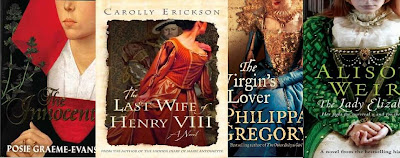
Ahh... another great historical fiction novel with a picture of a woman with her face partially obscured on the front. What is it about this genre that makes the creative departments so wary about putting an ACTUAL FACE on the cover? Are they worried that people will take one look and dismiss the title instantly?

"Bess of Hardwick's nose was not NEARLY that aquiline. I can't POSSIBLY read this. Get me something faceless."

Perhaps...

I am currently suffering from a massively painful neck injury. As I can't think of a single thing I have done recently to warrant any sort of physical strain I have come to the anxious conclusion that I probably have meningitis.

THUS I toddled off to the library to pick up some light reading. Don't worry, I won't inflict the Maeve Binchy I read on you, but this novel was fine actually. Chadwick's historical detail is always very well researched, her men are suitably courageous and tortured and the women are beautiful and normally quite erratic. This is a very early novel of Chadwick's and I think her writing style has improved over the years, (if memory serves some of them actually have a plot) but overall I didn't regret the few hours I spent reading this.

If I fail to post over the next few days it is because I no longer have the strength to lift my head from the pillow. I know this post is not up to my usual rambling length, so I leave you with some pictures...


Rating: 6/10.

20 March 2009

The Paris Enigma (Pablo de Santis)

Hmm hmm hmm. This is another one of those books I've been selling like crazy to customers and telling them I loved it, best book I've read all year etc. without actually having read it. However, unlike The Good Mayor, I ended up a) a bit disappointed and b) realising I've been lying to my customers. (I feel I should add in here that I do usually read books before recommending them, its just I haven't always read the book I want to recommend... I hope this doesn't call into question my reputation as a bookseller. I really do read things..I swear!)
Anyway...

The Paris Enigma is set during the World's Fair in Paris in 1889, (the fair which the Eiffel Tower was built for) and if you know me at all, the fact that it is Paris in the 19th Century should tip you off as to why I picked it up. For the World's Fair the twelve greatest detectives in the world are coming together to talk about their greatest cases. The group is known as...The Twelve Detectives. Right. Catchy!

A few nights before the grand opening of the fair, one of the detectives is killed leaving the remaining sleuths to solve the mystery of his death.

On first glances, this book could not be more perfect for me: Paris, mystery, historical fiction, cover that looks like a vintage poster... Being a bit of an Agatha Christie girl, I went into it thinking (hoping?) it would perhaps be a Parisian take on And Then There Were None. The problem was, when the mystery had been solved (with a few more bodies turning up along the way) I was seriously underwhelmed. I am used to the fantastic Poirot, where everyone is the killer/I am the killer/no-one is the killer and it all comes out in such a clever way that no-one else in the world aside from Poirot could have figured it out (except perhaps Marlowe....). At the end of The Paris Enigma, I was left thinking, well I could have figured that out. None of the ingenuity I was expecting.

So I guess the moral of this story seems to be if you want a good mystery* go for Christie.

6/10.


*I say mystery because I do not read modern 'crime' novels which are way too slasher-y and thriller-y and violent for my poor, feeble sensibilities.
Search Engine Submission - AddMe