Showing posts with label Historial Fiction. Show all posts

28 May 2011

The Empress of Ice Cream (Anthony Capella)

I'm not entirely sure why I enjoy Anthony Capella's writing so much. Is it the gastronomic erotica that he writes with such ease? Or is it the vulnerable characters he writes with such panache? The romances?

No, not the romances. He is not good at that.

And nut the vulnerable characters. I don't like reading about vulnerable characters. I like reading about people filled with unbelievable strength, charisma, sexiness and boldness. In short, I like my characters to be straight up Mills and Boon caricatures.

Joking!

(Sort of).

But I am pretty sure it is the gastronomic erotica that draws me to Capella's novels. Take The Food of Love for example. It is set in Rome and centres around a young, talented chef cooking entrails and offal for the love of his life in the hope that she will be aroused by eating such earthy, bloody foods and find herself also in love with him.

It works.

I have my doubts.

But The Empress of Ice Cream is the focus of this review. It is Capella's latest and tells the story of a young, penniless apprentice ice cream maker who rises to glorious heights in both the courts of France and England as he makes ice cream confections for the royalty.

I have always been a bit ambivalent about ice cream. I would rather devour a cheese plate for two than eat ice cream. But now I find myself drifting into the ice cream camp. Who wouldn't be seduced with the promise of strawberry ice cream garnished with peppermint cream and topped with a sprinkling of white pepper? Or the luxury of champagne and peach ice cream? Or the unbelievably heavenly taste of white chocolate and red currants?

The romantic story was negligible and the historical events are arguable, but the sheer deliciousness of this tale cannot be questioned. If you like fluffy grastronomic stories, you will read this story with the desire to lick every page in hopes that some of the creamy dreamy loveliness will actually emanate out of the words into your mouth.

Rating: 7/10.

02 November 2009

The Heretic's Daughter (Kathleen Kent)

I have this thing about the Salem Witch Trials. It's like my thing with the Amish. I'm don't want to BE Amish, I'm just overly and unnaturally fascinated with them. Salem- I don't wish I'd lived during the trials (with my hair and no straighteners available I'm sure I would have been scruffy enough to create suspicion) but I LOVE reading about it.

I bought this in Hatchards (LOVE this bookshop, want to get married and live and DIE in this bookshop) on Earhart's recommendation. Apparently she sold it to loads of customers last Christmas, not having actually read it herself. We both read it during Earhart's London visit and the sister, having read it first, insisted she would do the review. Well, I am ignoring that and doing the review myself because she has a lot on her plate at the moment and I have to work hard to come up with enough things to do to avoid filling out uni applications.

I know it sounds like Earhart and I did nothing but read whilst she was here on her three week visit, but we did talk to each other! We ate and drank a lot as well. And we spent a seriously enjoyable two hours in Wales sitting in armchairs, eating strawberry sours and quizzing each other from a Film Trivia Book we bought for 50p. Exciting stuff.

I digress... back to the book. Which was so unremarkable I have to go grab it off the shelf to remind myself of the title. Ah yes, The Heretic's Daughter. Meh, meh, meh. I have trouble feeling sympathy for a woman who is hung as a witch when she spends her time physically and emotionally abusing her children.

Sarah, the 'heretic's daughter' as it were, reminds me slightly of a Joanne Harris character. She is wilful and troubled and hard to like and the relationship with her mother Martha seemed overly reminiscent of the tempestuous relationship between Framboise and her mother in Five Quarters of the Orange. Although, not nearly as well-executed.

There is also some mysterious red book with the history of Sarah's father in it which is mentioned once and then all but forgotten. Sarah is allowed to read it when she comes of age, but she never tells us what is in it. A ridiculous and redundant side-plot.

The writing does the job (the job being the telling of an average plot and detailing of average characters) and that's it. If you're in the market for some mildly compelling and clichéd historical fiction, this is it.

Rating: 5/10.

07 October 2009

Booker Prize 2009

Hilary Mantel has won the Booker Prize for her novel Wolf Hall. Click here to read my earlier post on the Booker where I decided Mantel would definitely NOT win. It is an insightful post.

I will write no more on the subject because I am in bed, although it is the early hour of 7:51 pm. I am finishing up John Kennedy Toole's A Confederacy of Dunces and I have not been this excited about a book since Vernon God Little. Stay tuned for a sickeningly positive review.

01 October 2009

Restless (William Boyd)

This was a very tolerable read. I know that sounds lukewarm but it's actually quite positive compared to the review I was composing in my head before I had even started William Boyd's Restless. This is because it came out at around the same time as Paul Auster's The Brooklyn Follies. I detested The Brooklyn Follies and because Boyd's novel had the unfortunate luck to come out in the same month they are now intrinsically linked in my mind.*

Nonetheless, I was moved to pick it up the other day from a box of books advertised for 50p in Clapham. I came away feeling most pleased with myself, having grabbed Helen Garner's The Spare Room, John Kennedy Toole's A Confederacy of Dunces and something else I have now forgotten the name of. The universe, it seems, was telling me to read Restless.

As I've already said, not a bad read at all. Instead of the cosmopolitan mid-life crisis I was expecting I was pleasantly to find that it was actually a WW2 espionage 'thriller'. I say 'thriller' because the action/adventure part was a bit geriatric. The most exciting thing that happens is a Mexican policeman gets stabbed in the eye with a pencil.
As a relatively anxious person I don't look normally head for the thriller section of a bookshop. If I'm going to be scared I want it to be supernatural so I know there's absolutely no chance whatsoever it could actually happen to me. So I'm not complaining that this didn't have me cowering in terror from the shadows in my loft. I'm just being pedantic and saying that Time Out's comment that it is "heart-stoppingly exciting" would indicate that the reviewer didn't actually read the book.

I particularly liked the way the novel was structured- in ambience as well as tense. The story switches between a young woman who is recruited by the British Secret Service at the beginning of WW2 and her daughter, decades later, whom she enlists to help settle old ghosts. Eva Delectorskaya as an old woman fearing her past demons adds a surreal menace to the text. As the reader I had trouble believing that anyone would actually go after a grandmother who spends all of her time gardening. It is her rising paranoia rather than any actual events which propel the drama along.

Boyd's main problem seems to be his inability to adopt the female mindset and write, realistically, from the point of view of women. Ruth (the daughter) is strong and independent but comes across as cold, which I don't feel is at all deliberate on Boyd's part. Eva as the young, beautiful spy is a mere caricature, sort of like a particularly intelligent Bond girl. Had Boyd managed to inflate these characters into a three-dimensional state the novel could have been quite a bit better. As it stands, it is merely a non-trashy historical fiction novel with some mildly exciting action halfway through.

Rating: 7/10.

* I THINK. I could be wrong and they came out at completely different times. Maybe their covers are the same colour.

24 September 2009

Small Wars (Sadie Jones)

I am trying to create the perfect ambience to write this review, as I have been putting it off for a week and I think that perhaps it is my writing environment that is the problem. I am snuggled on the couch with coffee and a blanket- temper and temperature have been catered to. I have changed my wallpaper to an Antoni Tàpies painting to imbue me with inspiration and superimposed a picture of Daniel Craig on it to make it more interesting. Radiohead's Exit Music (For a Film) is playing to suppress my mood in hopes of directing my concentration to the task at hand.

Small Wars by Sadie Jones...

Is it well-written? Without a doubt. Jones has a deft, no-nonsense approach to her writing. She comes across as an incredibly creative and articulate author who has no patience for flowery prose. Her writing always seems to have been reined in to within an inch of its life, yet still, determinedly, beautiful sentences blossom on the page.

Is it compelling? Sort of. Like Ian McEwan, Jones has a knack for creating tension from the most inane of moments. Was she able to twist my stomach with anxiety and excitement like McEwan does? No. However, maybe she wasn't going for the clamorous, institutionalised menace that McEwan favours. Maybe Jones was AIMING for soft core tension.

Is is predictable? No... to her credit it is not. I picked the extramarital affair within the first couple of chapters and felt a rising scorn for this second offering from Jones. Compared to The Outcast I was preparing myself to be most disappointed with this follow up. Then, suddenly, OUT OF THE BLUE, the plot does an abrupt 180 and the reader is left scrambling to work out what just happened.

I think the main problem I have with the novel is tempo. It has a relatively slow and uneventful story line throughout and then a huge amount happens within about 15 pages. And then it ends. The denouement I also have a problem with. Is it ambiguous or is it lazy?

If pressed to tell you what the book is actually about I can't sum it up in a way that sounds interesting. Hal Treherne has been posted to Cyprus in 1956. His young wife Clara and their twin daughters join him. Mild tension ensues. This inane synopsis should not deter you. If pressed to produce a blurb of In Search of Lost Time I would probably come up with something similarly lacklustre.

That's not to say I think Jones is on par with Proust. But you get my drift.

All in all, a good, solid novel, lacking the raw intensity of The Outcast but perhaps, instead, demonstrating a more polished writing style. Whether or not this is a good thing... sigh. I don't know.

Rating: 8/10.

06 September 2009

The White Queen (Philippa Gregory)

The White Queen.
Not to be confused with The Other Queen.

Ye gods Philippa, at least PRETEND to try.

The name is only the pastel coating on one massive Paris almond of trouble. The Other Queen was quite bad. I didn't finish it, mainly because it jolted between three narratives and NOT ONE of those characters was mildly enigmatic. I'm sure they were interesting in real life, but Gregory, with this new magic of hers which has only surfaced in recent novels, managed to strip them of any remarkable characteristics or three-dimensional thoughts... a feat you must agree is impressive when one of the characters is Mary Queen of Scots.

Not a shrinking violet by any means.

However, in The White Queen Gregory has taken the gormless narrative to a new level of inanity. Her protagonist, the Lady Elizabeth Gray, tells of Edward the Usurper's rise to the throne, the death of her husband and her family's swinging loyalty all within the first page. She meets the king on the third page. She pleads her case, she makes him endure a mild bout of playing hard to get and VOILA they are married. The coronation is grand. Her family's new found power is cemented with several strategic weddings. Uproar! The man who put Edward on the throne is planning to put his brother on the throne instead!

This was a very VERY fascinating period in history. The warring houses of Lancaster and York were both deluded as to their own importance and grabbed what they could accordingly. So it is a splendid, nay, GLORIOUS feat on Gregory's part to have rendered these events monotonous and inconsequential. The above events I just described to you have all occurred within about the first three chapters of the novel. This, Ladies and Gentlemen, is where I stopped reading.

For one, it is exhausting to read at that kind of pace, especially when the quality of the writing is akin to something Mr Squiggle would churn out if he had to give a history lesson. Secondly, I have no love or hatred for any of the characters. None are captivating, all are stick figures in terms of development. (Admittedly, this is probably where Mr Squiggle could actually be of use.)

At the pace the novel is going I assume this (not small) book will cover about three hundred years of English history. Whilst useful for cramming for an exam on this period (admittedly, an exam at the University of Inferiority, where my major would be 'History Taught Succinctly and Melodramatically') I have no other use for this novel.

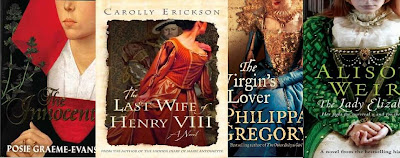
Oh and the cover is embarrassing. I feel self-conscious on the tube.

WHAT HAPPENED GREGORY?

You used to be FAB!

The Other Boleyn Girl? That was brilliant!

The Virgin's Lover? Intelligent bodice-ripping at its very best!

Do you know what I think, dearly devoted readers? I think Philippa has stopped writing. This and the last novel (The Other Queen) are terrible. The only reason they were published is because they have her name attached to them. THUS I strongly suspect Philippa is using her millions to holiday in Barbados and has left her ideas for plot lines and characters lying around her house. Great Aunt Millicent (who is house-sitting) has found these notes and decided to do Philippa a favour and bang out a couple of novels. Unfortunately, Great Aunt Millicent is not very worldly and her only foray into reading has been historical Mills and Boons.

In light of this, I suppose we have to cut her some slack. Milly, these are not that dreadful, all things considered.

If, however, my hypothesising is incorrect and Philippa is just churning out this junk herself... I profess myself disappointed.

Rating: 2/10.

I've just remembered I reviewed an earlier work of Gregory's (that I was less than enamoured with) here. Nevertheless, her current work is more substandard than anything I could have imagined.

And we've changed the font to accomodate Internet Explorer/ Safari/ Firefox and Google Chrome. You're welcome.

26 August 2009

Author Love: Sadie Jones

This is just a quick post to point you in the direction of this Guardian article on Sadie Jones' new novel Small Wars. I have a special place in my heart for The Outcast, her first novel which was released early 2008. It was the first novel I managed to read through in its entirety without falling asleep following an unfortunate glandular fever episode. I know the covers look a little mass-markety but Jones is a splendid writer who deals with relatively disturbing issues. Below is a review I wrote for the bookshop... short and sweet and not in the slightest verbose... I must have still been sick.

"My initial apprehension before reading this novel came from the comparisons it has had to Ian McEwan and Kazuo Ishiguro. I need not have worried, Jones has given us a beautiful yet sparingly written novel about a young boy's childhood after the death of his mother. The subsequent traumatic events are dealt with tastefully and honestly and the characters are incredibly constructed. Corseted to a distant father and immature stepmother, Lewis becomes increasingly alienated from the small Surrey neighbourhood in which they live and seeks stimulation and redemption in seedy London nightclubs. Jones has created a wonderful tale, polishing what is essentially a very basic plot line until it resonates off the pages and can be considered worthy of the comparisons which have been made."

A review of Small Wars will follow shortly.

06 July 2009

The Texicans (Nina Vida)

Before I start off properly I think I should give you a definition of 'Texican'. My reason for doing this is that I was a bit prejudiced against this book before I read it. I assumed there was no such word and the author was being a tad pretentious/illiterate (depending on whether or not it was deliberate). Then I looked it up and... oops. Sorry for calling you pretentious Nina; a Texican is either someone who lived in Texas when it was the Republic of Texas, OR it's someone who is Texan of Mexican descent. Either fit within the confines of the novel...thank you urban dictionary.

So misconceptions about the novel out of the way, it was in fact a good read. Historical fiction, set in Texas in 1800s, a period about which I know very little outside what Little House on the Prairie taught me. Which isn't actually set in Texas but they do travel in a wagon 'west' and with my limited geographical knowledge of America that'll do!

Set over the course of a decade, this is one of those family saga stories, mainly focusing on Joseph Kimmel, a Jewish school teacher from Missouri (I think) who travels across Texas after the death of his brother. Despite being quite snarky and extremely solitary, he manages to pick up a wife, a runaway slave, a Mexican witch, an amputee and his family along his journey. He builds a ranch, gets attacked by Comanches, goes up against some very corrupt Texas rangers and generally achieves WAY too much for one character in one book.

I could have done without a few of the more graphic scenes, like when the Comanche chief is eaten alive by a warring tribe. Or when Joseph accidentally eats human meat - my dislike of those scenes is obviously due to my being a bit squeamish. And maybe I missed the point of the book (but I really don't think so) but I believe the ending needed to be altered slightly, i.e. I think it should be changed to the ending I was expecting. Considering I put up with doom and gloom and cannibalism and gratuitous violence I reckon I deserve a happy ending.

6/10.

24 June 2009

The Shadow of the Wind (Carlos Ruiz Zafon)

Coming to you live on Alcott and Earhart, the inaugural and probably the last 'Book-you-probably-didn't-miss-but-I-did-miss-until-just-now' post. I feel like I am just about the last person in the world (or at least in my bookshop) to read The Shadow of the Wind. After months of hearing from a colleague that it is one of her favourites/is so good/is a real cracker, after having droves of customers come in and ask for 'that book with the big book graveyard and it's Spanish I think' I finally read it. Never have I had more comments from customers when they saw what I was reading - every second person who came in expressed either joy that I was reading it or shock that I work in a book shop and was only just reading The Shadow of the Wind.

So I finally did it. The verdict? Very good.

1940s Barcelona, a boy is taken to the Cemetery of Forgotten Books where he must choose one book which he must treasure for life. He chooses The Shadow of the Wind by the mysterious Julian Carax, and becomes obsessed with unraveling the mystery of the author. In a nutshell.

Out of a nutshell - this book has got just about everything you could ask for - historical stuff, mystery, romance, musings on the wonder of literature, a psychopathic corrupt policeman, even comedy! I think that's the one that surprised me the most - there is a great character named Fermin, a once homeless man who befriends our protagonist Daniel, who doles out a few fabulous one-liners. And the thing is - this is a book that is not any one genre really, so if someone doesn't want romance, just don't tell them about it... it's not an overpowering plot element, so if they don't think it's a romance they probably won't care about the romance. (Going into bookseller mode a bit there).

So now you can either go read it, OR comment and tell me that you can't believe I've only just read it, being a bookseller and all...

8/10

01 June 2009

The Alchemy of Murder (Carol McCleary)

Just two months after The Paris Enigma was released (historical mystery, Paris, World's Fair, 1889) The Alchemy of Murder has arrived on shelves, giving readers more historical mystery, more Paris, more Worlds Fair, more 1889. Francophile and dedicated book reviewer that I am, obviously I had to read this second offering and see how the two compare.

Well.

The Paris Enigma - more 'literary' in a ladies book club sense of the word - you can read it and talk about the philosophy of crime according to De Santis, and pretend you actually read philosophy.
The Alchemy of Murder - more readable in the 'this is actually an enjoyable book to read sense of the word' - you can read it and you actually get a plot to follow along with.

Nellie Bly was a real person back in the 1880's - the first female reporter in America who famously went under cover in a mental asylum to expose the horrific treatment of the inmates. In The Alchemy of Murder, it is during Nellie's stay in Blackwell's Asylum that she discovers a madman who is killing the prostitutes of New York. He escapes the asylum during a fire, but Nellie follows him to London, and then onto Paris where he wreaks havoc during the worlds fair.
You get a real flavour for Paris in the 1880s here - we have anarchists, prostitutes, Louis Pasteur, Oscar Wilde, Jules Verne...the list goes on. Civil unrest! Murder Plots! Slashings! I'm getting hyped up just typing this!

My only problem with this book is the slight weirdness of using real historical characters and playing with them for the sake of your plot. I can't imagine Louis Pasteur ever imagined he would turn up in a historical murder mystery 100 years down the track. Plus, there is this whole weird romance which develops between Nellie and Jules Verne. Jules Verne as a romantic lead is a little much for me to swallow quite frankly.

However weird romance aside, this book is one to delve into if you are after a good historical mystery, with an interesting plot, interesting anarchists, and a 1880s feminist heroine with a vendetta against a murdering psychopathic maniac.

7/10

06 April 2009

The Pillars of the Earth (Ken Follett)

I read this on my second week in London. I was living in a hostel, the new Best Friends Forever I'd met the night before had moved on to Libya and I was sitting in the common room being chatted to by a very intense young German man who spoke very little English and talked for fifteen minutes straight about the washing tokens the hostel offered and the different options available to us. He left to go check on his delicates and I pounced on the nearest book at hand, planning to be fully engrossed by the time he came back.

First chapter in I was slightly panicked. How was I going to feign excitement and engrossment in a thick as a brick tome on cathedral building in the middle ages? The Pillars of the Earth... for CRYING OUT LOUD... I might as well have grabbed the dictionary.

Second chapter in I went up to bed early, book in hand.
Half way through and the next morning at breakfast I barely gave the SPANISH GOD in the corner a perfunctory once-over.

Admittedly the writing is a little pedestrian, the relationships tedious and predictable and the character of Tom Builder hard to take at times.

But really, if it's a book about cathedral building and I couldn't wait to get back to it in between sight-seeing, I'm thinking there's something good about it. Fully recommended holiday reading for those who don't mind paying extra for excess baggage weight.

Rating: 7/10.

24 March 2009

Shields of Pride (Elizabeth Chadwick)

Ahh... another great historical fiction novel with a picture of a woman with her face partially obscured on the front. What is it about this genre that makes the creative departments so wary about putting an ACTUAL FACE on the cover? Are they worried that people will take one look and dismiss the title instantly?

"Bess of Hardwick's nose was not NEARLY that aquiline. I can't POSSIBLY read this. Get me something faceless."

Perhaps...

I am currently suffering from a massively painful neck injury. As I can't think of a single thing I have done recently to warrant any sort of physical strain I have come to the anxious conclusion that I probably have meningitis.

THUS I toddled off to the library to pick up some light reading. Don't worry, I won't inflict the Maeve Binchy I read on you, but this novel was fine actually. Chadwick's historical detail is always very well researched, her men are suitably courageous and tortured and the women are beautiful and normally quite erratic. This is a very early novel of Chadwick's and I think her writing style has improved over the years, (if memory serves some of them actually have a plot) but overall I didn't regret the few hours I spent reading this.

If I fail to post over the next few days it is because I no longer have the strength to lift my head from the pillow. I know this post is not up to my usual rambling length, so I leave you with some pictures...


Rating: 6/10.

20 March 2009

The Paris Enigma (Pablo de Santis)

Hmm hmm hmm. This is another one of those books I've been selling like crazy to customers and telling them I loved it, best book I've read all year etc. without actually having read it. However, unlike The Good Mayor, I ended up a) a bit disappointed and b) realising I've been lying to my customers. (I feel I should add in here that I do usually read books before recommending them, its just I haven't always read the book I want to recommend... I hope this doesn't call into question my reputation as a bookseller. I really do read things..I swear!)
Anyway...

The Paris Enigma is set during the World's Fair in Paris in 1889, (the fair which the Eiffel Tower was built for) and if you know me at all, the fact that it is Paris in the 19th Century should tip you off as to why I picked it up. For the World's Fair the twelve greatest detectives in the world are coming together to talk about their greatest cases. The group is known as...The Twelve Detectives. Right. Catchy!

A few nights before the grand opening of the fair, one of the detectives is killed leaving the remaining sleuths to solve the mystery of his death.

On first glances, this book could not be more perfect for me: Paris, mystery, historical fiction, cover that looks like a vintage poster... Being a bit of an Agatha Christie girl, I went into it thinking (hoping?) it would perhaps be a Parisian take on And Then There Were None. The problem was, when the mystery had been solved (with a few more bodies turning up along the way) I was seriously underwhelmed. I am used to the fantastic Poirot, where everyone is the killer/I am the killer/no-one is the killer and it all comes out in such a clever way that no-one else in the world aside from Poirot could have figured it out (except perhaps Marlowe....). At the end of The Paris Enigma, I was left thinking, well I could have figured that out. None of the ingenuity I was expecting.

So I guess the moral of this story seems to be if you want a good mystery* go for Christie.

6/10.


*I say mystery because I do not read modern 'crime' novels which are way too slasher-y and thriller-y and violent for my poor, feeble sensibilities.

18 February 2009

Fallen Skies (Philippa Gregory)

Philippa Gregory used to be a sure thing.
Oh, I wouldn't say she writes well.
At all.
I would say she knows EXACTLY how much factual information to insert into her historical fiction; and she is able to gauge to within a paragraph when our attention is beginning to wane so she can slip in a bodice-ripping scene or two. No problem really... that's my kind of thing and it's why I read her. There's nothing better to curl up with on a rainy day than hot chocolate and loved-up Tudors who could, at any minute, lose their heads.

However, lately, Gregory has been stumbling a bit, churning out any old rubbish and hoping mega ruffs and her name on the cover is all that is needed to sell the books. The Other Queen (2008) was absolute junk: Gregory turned one of the most fascinating women in English history (Mary Queen of Scots) into a boring, vacuous Mills and Boon heroine; and the plot read like a Radio 4 dramatisation on a particularly off day.

I thought perhaps Gregory was losing her touch and needed some sort of getaway at a historical fiction writer's spa. The sort of place where authors swan around in velvet, empire-waisted gowns with ridiculous sleeves and talk about codpieces and how Henry VIII is so over right now, their faces plastered in mashed haggis.
Mashed haggis?
Because I can, that's why.

However, having just finished Fallen Skies which came out in 1993 I have come to the realisation that Gregory's success with The Other Boleyn Girl and the others in the Tudor series was perhaps a fluke and now she is regressing back to where she began.

Fallen Skies was, first of all, a complete disappointment between the bedsheets. Our heroine Lily (who is quite, quite annoying) has two lovers: one is her husband Stephen who prefers her to impersonate a starfish during the act so she doesn't display wanton desires; and the other is Charlie, her true love, who had his man bits blown off during the war.
Sigh.
WHY, Philippa, WHY?

Then of course, we have the sinister nanny who we are immediately suspicious of. Several of her previous charges have died in mysterious circumstances. The author appears to forget about this as the nanny is phased out of the story and never returns. Misleading the reader is something I do not look favourably upon so this added to the fact that she led me on in thinking Stephen was gay made me doubly peeved. (I was sure all that time he spent with his mute chauffeur eating grilled cheese sandwiches was fishy. Apparently not.)
Gregory also appears to lose any enthusiasm she may have had for finishing the novel properly. It is a slow, sexually frustrated snail of a book until the last chapter, when it finishes so quickly, with no resolutions or sense, that we can only assume that's when the plot line of The Other Boleyn Girl came to her and she rattled off the end any which way.

Much as I'm doing now...

Rating: 5/10.

24 January 2009

The Book of Unholy Mischief (Elle Newmark)

Set in Venice, at the dawn of the
Renaissance, this book seemed
promising. Luciano is a boy from the streets, lucky enough to be taken in as apprentice to the chef in the Doge's palace. Working in the kitchens of the palace, Luciano is witness to the wheeling and dealing which goes on between the council, the doge and various members of the Venetian aristocracy. The most significant topic of conversation at ducal dinner parties is the existence of a book, brought to Venice from the Byzantine empire, which contains the key to power in Venice. The doge wants it because he believes it will grant him eternal life, the council members want it because they think it will get them gold, even the pope gets in on the action. Mixed in with all the courtly intrigue are numerous descriptions of the food which Chef Ferrero prepares, and uses to influence the doge and his dining companions.
I went into this book with ridiculously high expectations. For starters: I love Venice, I love the Renaissance, I love food - perfect! Add to that the fact that it has received amazing review after amazing review, including one in Bookchat which was supposedly written by me... It received the Rep's Choice Award 2009, and just about everyone I've spoken to has raved about it. That said, I was seriously underwhelmed. I was told this was the kind of book you read in one sitting, because you just can't put it down. It took me a couple of weeks to get through it because every time I put it down, my interest in it vanished. It was enjoyable while I was actually reading it, but there was nothing about the story that really hooked me in. The writing was good, the descriptions of food in particular - was constantly hungry while I was reading it, and the initial premise was good, it just didn't quite work in the end. Although I will admit, that maybe I stand alone with that judgment. 5/10
Search Engine Submission - AddMe